
 Home»
News
On October 17, Mario Capecchi, the 2007 Nobel laureate in Physiology or Medicine, a pioneer of gene-targeting technology, and Distinguished Professor of Human Genetics and Biology at the University of Utah, visited NWAFU. He was appointed an honorary professor of the university and delivered an academic lecture to faculty and students. NWAFU President Wu Pute met with Capecchi and presented him with the certificate of appointment. Vice President Zhang Hongming also attended the meeting and chaired the lecture.
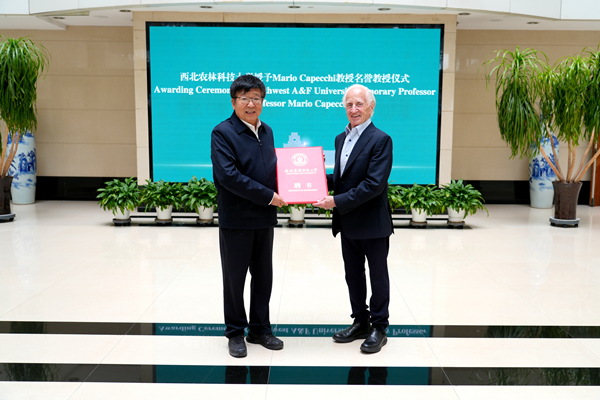
Wu Pute warmly welcomed Capecchi and introduced NWAFU’s recent advances in biological breeding. He noted that the gene-targeting technology pioneered by Capecchi represents a landmark breakthrough in the life sciences and a major contribution to the scientific community. In recent years, NWAFU has continued to strengthen support for disciplines related to future agriculture, with life sciences and information technology serving as two important scientific foundations for future agricultural development. Wu expressed hope that Capecchi would visit NWAFU more often for academic exchanges and pursue long-term collaboration with the university.
Capecchi thanked NWAFU for its warm reception and said that the students’ enthusiasm for knowledge had left a deep impression on him. Research is not easy, he noted, and students will encounter various difficulties and setbacks along the way. However, their passion for scientific knowledge is essential. He expressed confidence in NWAFU students’ abilities and creativity and said he believed they could achieve success in research. He also expressed his hope for active collaboration with the university.
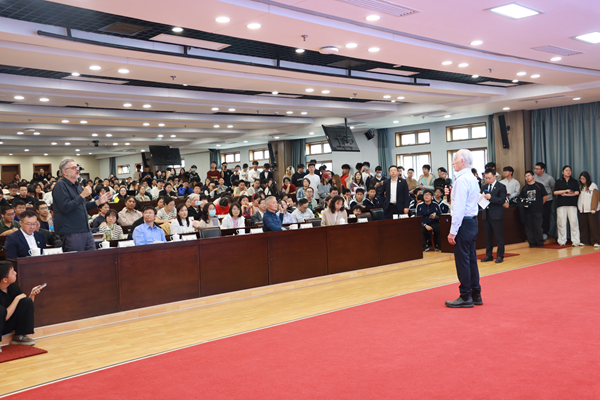
In his academic lecture, titled “The Making of a Scientist,” Capecchi drew on his personal experiences to recount his journey from a childhood marked by war to a career in molecular genetics and his role in pioneering gene-targeting technology. He emphasized the influence of education and mentors, the importance of choosing scientific questions, and the perseverance required when facing skepticism and difficulties. Students listened attentively and took notes throughout the lecture. During the Q&A session, they eagerly raised questions about technical details and challenges encountered in research. Capecchi answered each question, and the discussion was lively.
Capecchi’s visit and appointment as an honorary professor fulfilled a promise he made 16 years ago to return to NWAFU and give another lecture. The visit also marks an important step in strengthening NWAFU’s exchanges and collaboration with leading international scientists. It will provide valuable expertise and intellectual support for disciplinary development and young talent cultivation in animal breeding and gene editing, while further enhancing NWAFU’s academic influence at the intersection of the life sciences and future agriculture. Building on this visit, NWAFU will continue to expand international academic exchanges and encourage young people to sustain their curiosity and perseverance in science, contributing to national food security and agricultural modernization.
Born in Verona, Italy, in 1937, Capecchi received his PhD in biophysics from Harvard University in 1967 under the guidance of Dr. James D. Watson, often referred to as the “Father of DNA.” Capecchi is currently Distinguished Professor of Human Genetics and Biology at the University of Utah and an investigator at the Howard Hughes Medical Institute. He is a member of the U.S. National Academy of Sciences and the European Academy of Sciences. For his pioneering work on gene targeting, he shared the 2007 Nobel Prize in Physiology or Medicine with Martin Evans and Oliver Smithies. His honors include the U.S. National Medal of Science, the Kyoto Prize in Basic Sciences, the Albert Lasker Basic Medical Research Award, and the Wolf Prize in Medicine. Capecchi previously visited NWAFU on June 7, 2010.
Translated by: Tian Yiyun
Proofread by: Yan Xianhui


